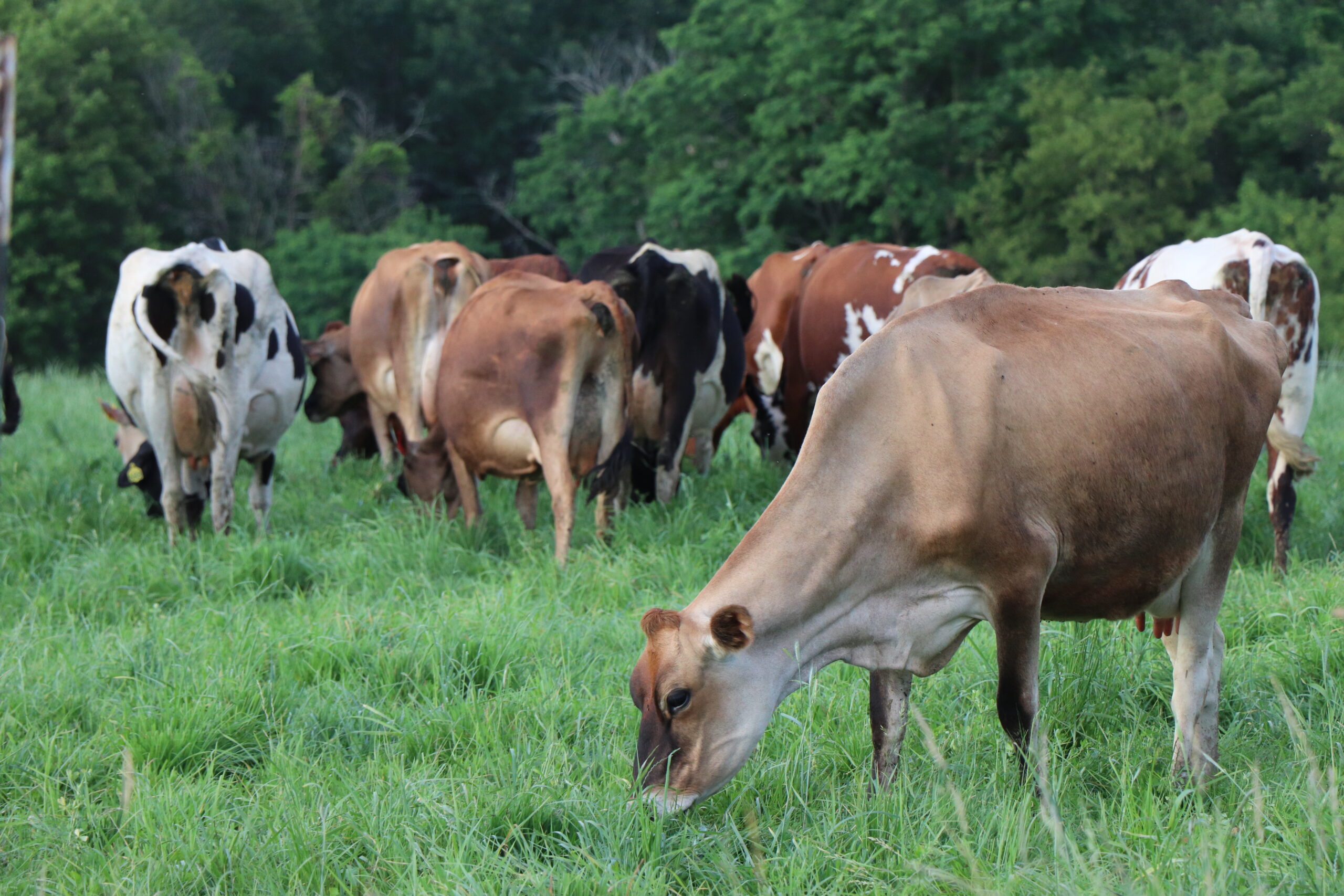
Cows graze in the headwaters of the Coon Creek Watershed. Managed grazing is one strategy for curtailing nutrient inputs to Driftless Streams
Sydney Widell | Watershed Coordinator
A decade after producers in the Tainter Creek watershed organized as a watershed council, a new study found that their efforts to increase managed grazing adoption in their watershed coincided with a 14 percent reduction in phosphorus concentrations in Tainter Creek relative to neighboring streams.
Lexi Wellman, who led the study as part of her masters program at UW-Madison, argued its results not only demonstrate the power of perennial practices to drive water quality improvement, but also illustrate the critical role producer-led groups play in advancing transformative land use change.
“Productive agriculture landscapes and clean water are not incompatible,” she wrote. “Impediments to this type of transformative change are mostly socially constructed, so we need innovative sociological approaches…to bring positive ecological change to agricultural landscapes.”
Between 2019 and 2022, farmers in the Tainter Creek Watershed helped enact this positive change as participants in the Tainter Creek Farmer-led Water Quality Project, a partnership that brought together Tainter Creek producers, Vernon County’s Land and Water Conservation Department, Valley Stewardship Network, UW-Madison’s Grassland 2.0 program, and national collaborators with the Wallace Foundation.
Ultimately, the project distributed $173,000 to Tainter Creek producers to implement conservation practices across 98 ha. It did so with a focus on converting annual cropping systems to well-managed grazing, and a goal of reducing surface water phosphorus levels while also supporting farm viability.
Phosphorus pollution to Driftless streams poses public health risks, and fuels water quality degradation and habitat loss from local trout streams to the Gulf of Mexico. For farmers, Lexi said phosphorous runoff also means that costly fertilizer inputs and soil resources are washed away and wasted.
While a significant amount of excess phosphorus is already stored in Driftless stream systems due to erosion and sedimentation caused by generations of intensive agriculture, managing ongoing nutrient inputs can help prevent the problem from growing. Perennial agriculture, like managed grazing, is one way to protect soil and prevent nutrient loss.
During and after the Tainter Creek Grazing Project, volunteers, local collaborators, and university partners conducted water quality sampling in and around Tainter Creek to measure the impact of their land use transitions. By comparing trends in nutrient levels across these sites over time, in combination with other factors like precipitation, Lexi was able to relate the nutrient level reductions she observed in the Tainter Creek Watershed with the increase in grazing adoption occurring there over the same period.
“Our study suggests that focusing conservation investment in transitioning agricultural land to well-managed perennial grazing provides a higher return on conservation efforts by addressing the fundamental nutrient imbalances among annual systems that drive Phosphorus loss,” Lexi wrote. “Scaling well-managed grazing practices rather than incremental Best Management Practices is likely to have a higher impact on successful nutrient reduction at the watershed scale and therefore help reach Total Maximum Daily Load goals more effectively.”
To bring about these land use transformations at scale, Lexi called for a shift toward outcomes based incentives, as well as broader access to specialized technical guidance, financial planning tools, and strategically integrated collaborations grounded in adaptive, human centered relational dynamics.
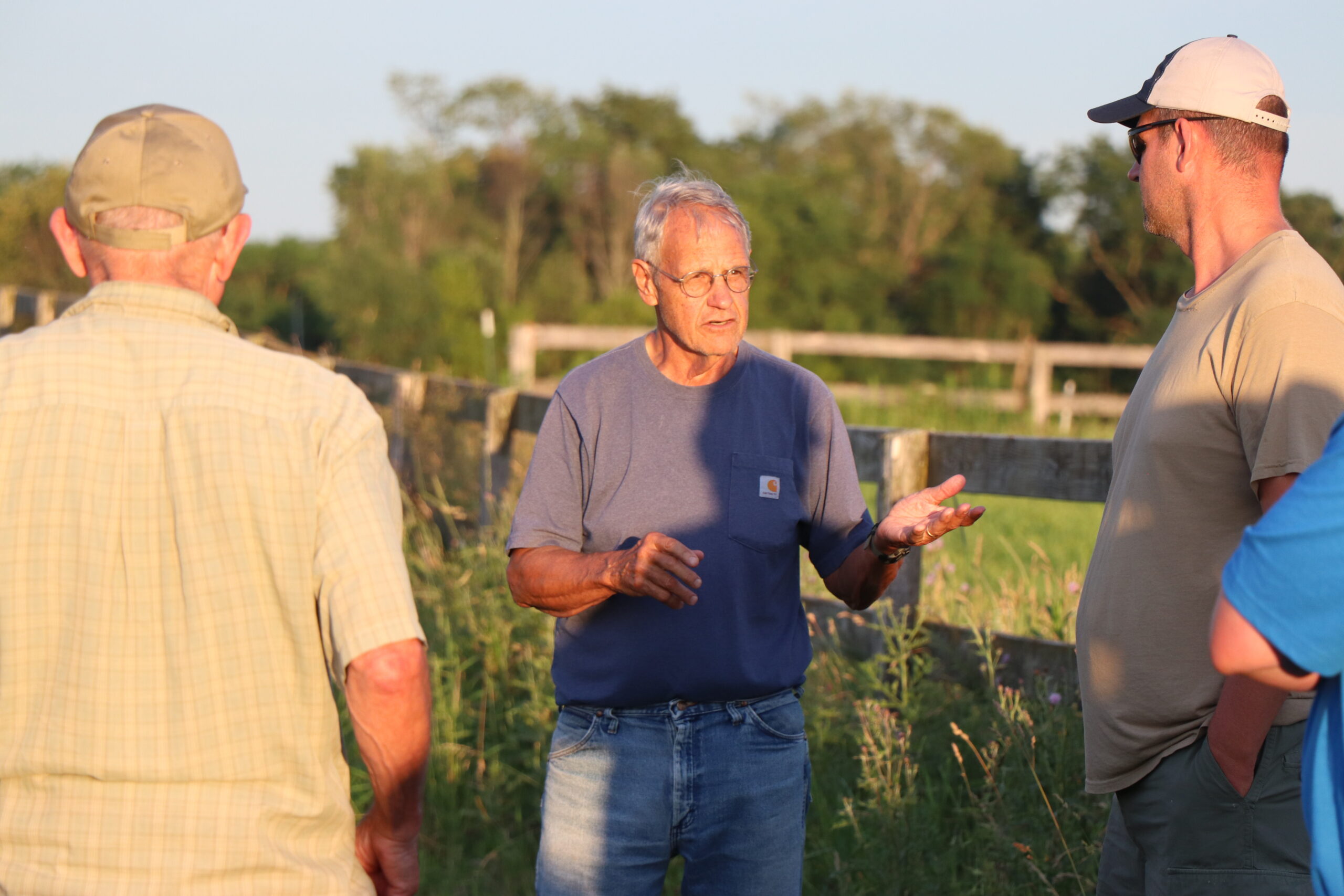
Jim Munsch at a 2024 field day. Jim will host the August 5th meeting at his farm in Coon Valley.
Lexi will share more results from her study at our next general meeting, happening 6pm August 5th at the Munsch Farm (s995 Bagstad Ln, Coon Valley). She’ll be joined by producer leaders from the Tainter Creek Watershed; as well as the Munsch family, who helped develop the economic analysis tools that supported grazing adoption in Tainter Creek. Our August 5th meeting is made possibe with special support from Valley Stewardship Network, via a Grazing Lands Conservation Initiative Grant. The event is free and all are welcome.
We are also pleased to offer cost share for managed grazing adoption to producers in the Coon Creek, West Fork Kickapoo, and Little La Crosse Watersheds. To request cost share, complete the form linked here.