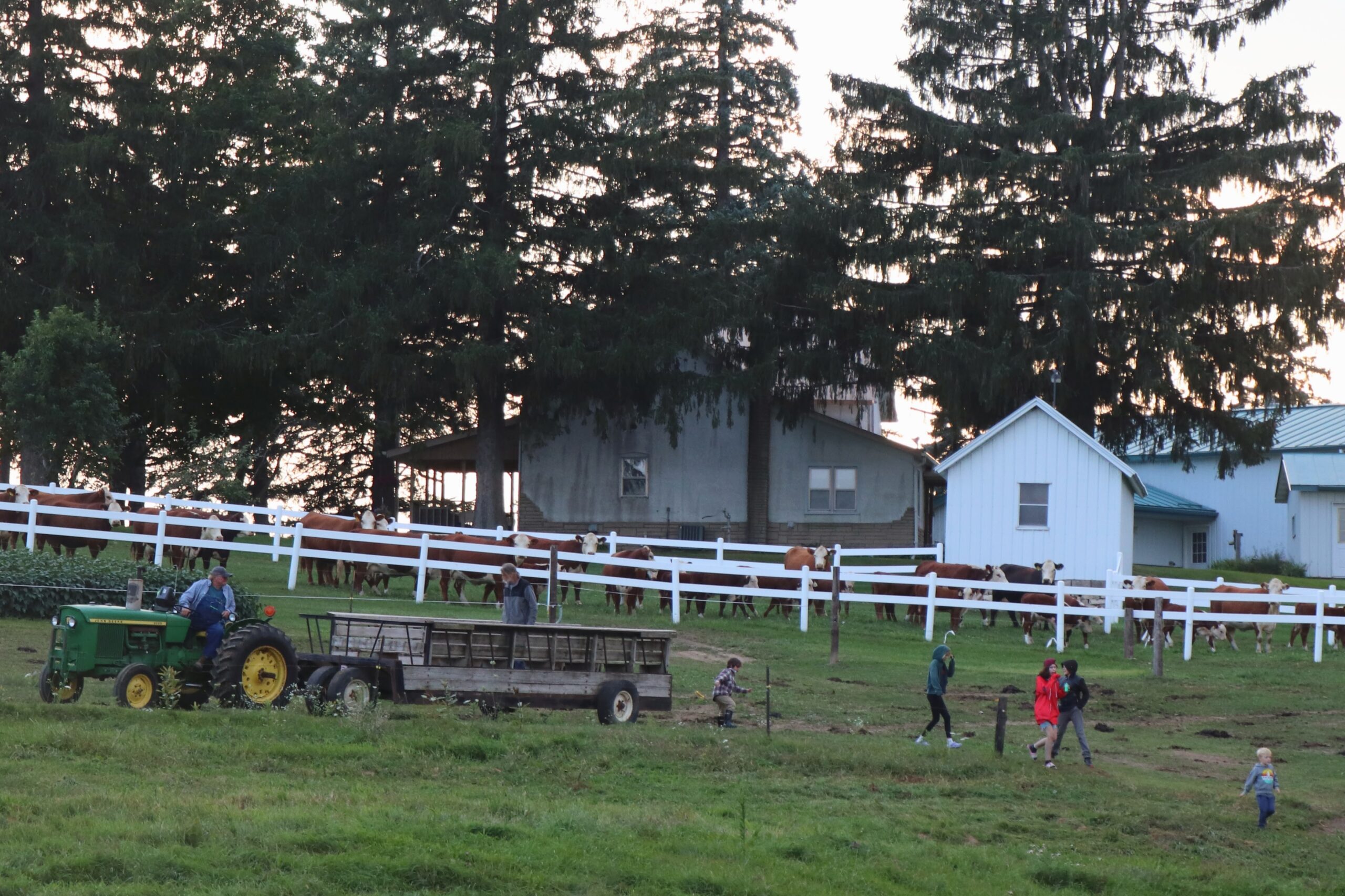
Mike Lindahl lets off a trailer full of guests at his farm on Hamburg Ridge during the Coon Creek Community Watershed Council’s 4th Anniversary Celebration in Sept. 2025. The Lindahls experiment with a range of soil conservation practices in their steep fields. Photo: Sydney Widell
Less than a month after Mike Lindahl laid the last grass seeds around the banks of his newly dug water retention pond last August, nearly two inches of rain fell in a matter of hours across the Coon Creek Watershed.
As the rain fell, Mike went about his morning chores, checking on cows and their calves. All the while, he kept an eye on his farm pond, and he watched with a sinking feeling as the freshly seeded waterways feeding into the pond unraveled, and knee deep gullies opened into the hillside.
When the storm passed, Mike went outside to inspect the damage. Most of the grass seed he had planted to shore up the waterways against this exact situation had washed away.
“It was disheartening. It’s not about the money, but it is disheartening to watch all your work wash out,” Mike said. “Once it starts washing, there’s not much you can do until the rain stops.”
Mike and his wife Sally graze cattle and grow alfalfa, corn, and soybeans with their childrens’ families on Hamburg Ridge, in rural Stoddard. The farm has been in their family for 98 years, with Mike at the helm for the last 40. During the time he’s farmed there, he’s experimented with soil conservation techniques including minimum and no till corn and soybean planting, cover cropping, and managed grazing.
To help cover the often prohibitive costs of adopting these practices, Mike has looked to the United States Department of Agriculture-Natural Resources Conservation Service (NRCS) and the Vernon County Land and Water Conservation Department for funding assistance–including programs like the ones that helped him build the retention pond.
The Vernon County Land and Water Conservation Department cost shared 70 percent of the $14,212 pond project, using funding it receives from local wastewater treatment plants to protect water quality. Mike covered the remaining 30 percent of the cost.
While retention ponds like the one Mike dug are designed to capture the excess sediment and nutrients that flow off of farm fields, they store and slowly release stormwater runoff as well, which helps reduce flooding and “makes running water walk.” They also support wildlife habitat, and can be a water source for farm animals.
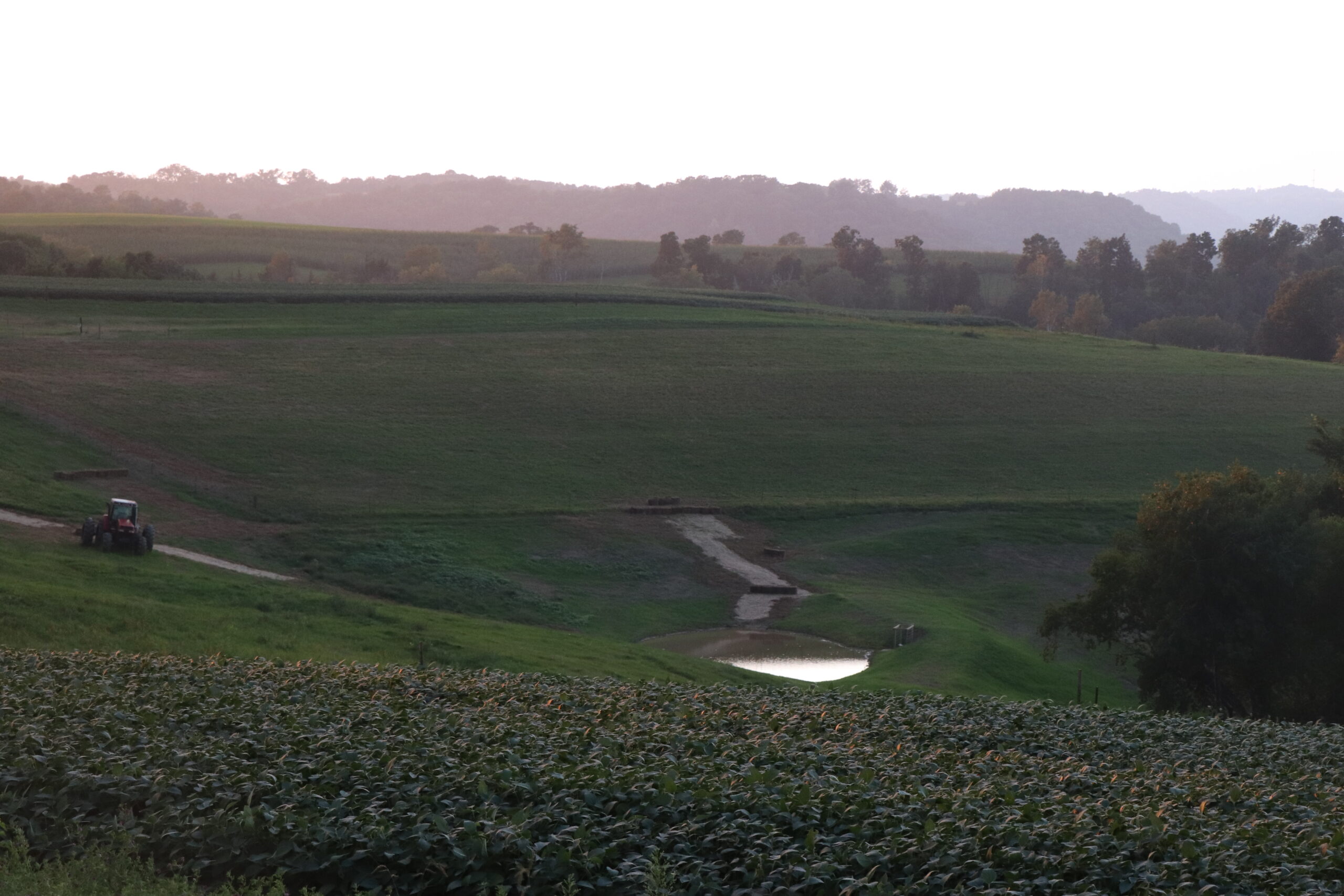
The Lindahls’ new farm pond, which is designed to capture the excess nutrients and water that flow off their steep fields. The grassed waterways that drain water into the pond washed out in a rainstorm just weeks after they were planted. Photo: Sydney Widell
Mike’s pond is nestled low on his fields, where it is supposed to collect water that drains from the land above along grass waterways. In the pond, water that doesn’t infiltrate into the ground should be released slowly through a drawdown structure. Packed soil stabilized with grass is designed to form an embankment around the pond.
But as is often the case in the Coon Creek Watershed, heavy rains had other plans, and the waterways draining into the pond washed out before the stabilizing grasses Mike planted had a chance to take root.
After the storm, Mike called a few contractors to ask about repairs. All the bids he received were at least several thousand dollars. He figured he could cut costs by doing the project himself, but there would still be the expenses of buying new seed, putting down stabilizing ground netting, and hiring an excavator to re-level the rutted-out waterways–not to mention the time he’d lose getting ready for the busy harvest season.
By chance, Mike’s contract with Vernon County was still open, so he was able to access additional cost share for the repairs. But he was still left with unforeseen expenses, on top of the costs of the project he had just completed.
Mike was also concerned because he was planning to showcase the project as the host of our 4th Anniversary celebration in Sept. 2025, which was only a few weeks away. He wanted to make the repairs quickly.
We had heard about the Lindahls’ pond project, and invited them to share it with our broader council membership as an illustration of an upland runoff management intervention that can enhance flood resilience in the Coon Creek Watershed.
When Mike explained the situation to our board, they didn’t think twice before voting to grant him $1,500 to help restore the pond before the September celebration. But the board also realized Mike’s story pointed to a much larger problem.
There is a wide range of state and federal programs that fund conservation practice adoption. But there are far fewer programs that also invest in maintaining those practices. Families like the Lindahls can be left on the hook for costly, unexpected repairs, and projects meant to enhance flood resilience and soil health in the Coon Creek Watershed might not work to their full potential because they don’t receive adequate maintenance. Or, these projects might be abandoned altogether.
In the Coon Creek Watershed, this pattern is a tale as old as the 1930s.
During the 1930s, Coon Creek residents collaborated with federal, state, and university partners to develop land management strategies like terracing and contour farming in what is now celebrated as the first watershed conservation project in the nation. These strategies significantly reversed the flooding and erosion crisis set in motion by intensive settler agriculture.
But as our president Nancy Wedwick pointed out, the decades following this massive federal project in Coon Creek have seen the abandonment or removal of many of the practices developed during that time, in favor of larger scale, more intensive agriculture.
These changes also correspond to a rise in increasingly severe floods in the Coon Creek Watershed. A 2021 UW-Madison study found the estimated 10-30 percent increase in total row cropping acreage in the Driftless Area between 2006-2017, enabled in part by the removal of conservation interventions that reduced erosion and promoted infiltration, has been accompanied by elevated flood peaks across the region.
Amid this urgent context, Nancy worries that the lack of funding for project maintenance can deter landowners from adopting the types of land management practices needed to mitigate flooding in the Coon Creek Watershed.
“The fact that you don’t always get help for maintenance is prohibitive,” Nancy said. “If you want to make sustainable environmental changes, you have to really sustain them. This was a gap we identified.”
That’s why, at the same time we were helping fund pond repairs at the Lindahl Farm, we were also developing our new Post Project Maintenance Program, which will open officially in January 2026. Through the program, applicants will be able to request up to $1,500 to offset the cost of project repairs, thanks to funding from the Rural Climate Partnership.
“Our strategy is to call attention to this gap,” Nancy said. “We can provide a small financial contribution, but long term this is a much larger problem and must be addressed on the policy level–through cost share programs that consider long term maintenance.”
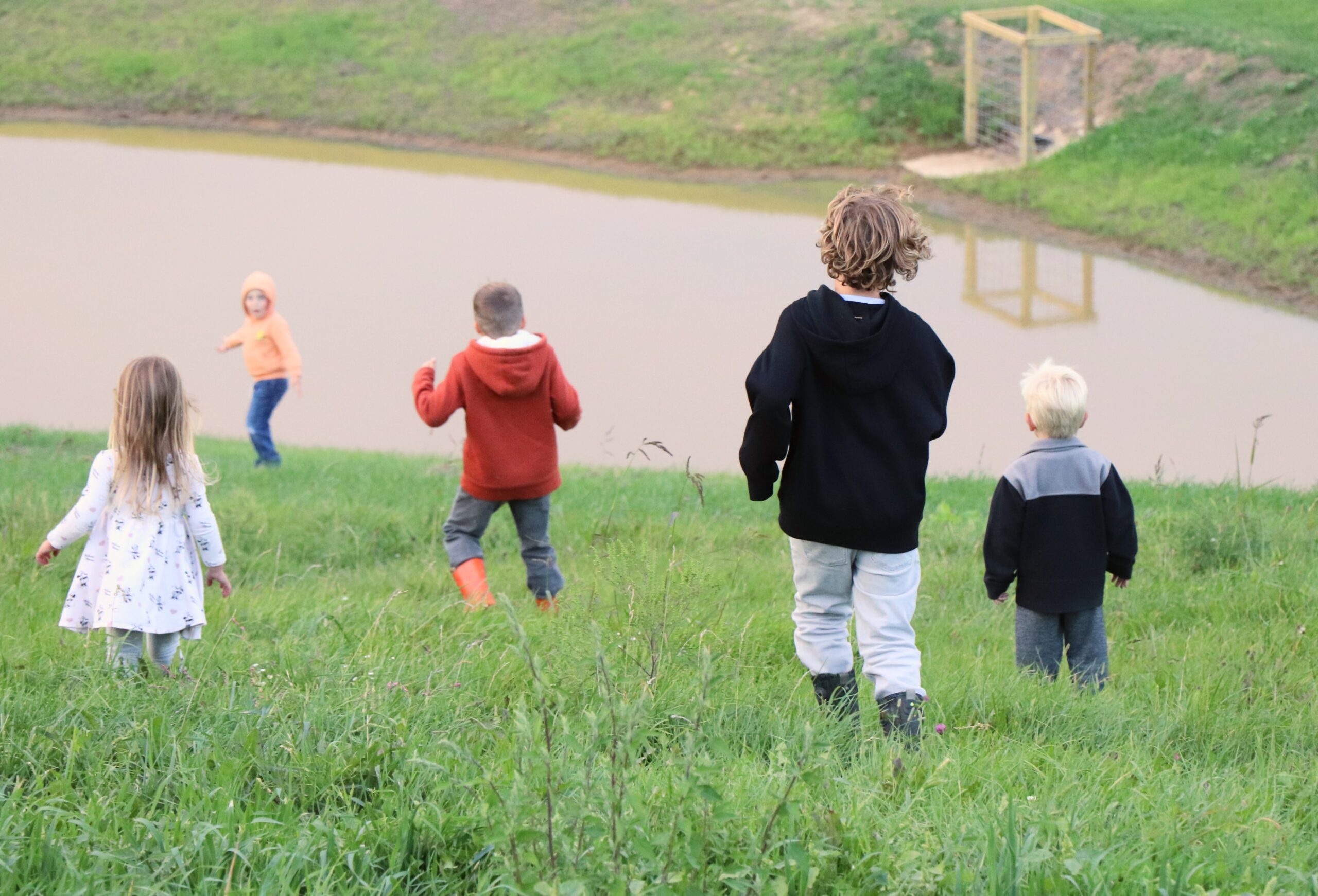
The Lindahls’ grandchildren and neighbors play along the banks of the new farm pond at the CCCWC’s 4th Anniversary Celebration. After the pond was damaged in a rainstorm, the Lindahls worked with Vernon County and the CCCWC to repair the project. Photo: Sydney Widell
Back on the Lindahl farm, Mike says his repairs are holding up. The grass is taking root, the gullies are gone, and water collects in the pond and infiltrates into the ground before flowing off the Lindahls’ fields.
“Everything seems to be good, it’s all grassed in,” Mike said. “It’s an ongoing thing, but it’s 100 percent better than when we started.”
Like all of our cost share programs, the Post Project Maintenance Program is made possible through community and foundation support. In 2026, we will seek to increase the maximum grant award, as well as the number of people it might serve.
Donations to the CCCWC are tax deductible and always welcome. Learn how to make yours on the CCCWC website.
Information for those interested in requesting funding will be available on our website in January 2026. In the meantime, watershed residents can learn more about this and other CCCWC cost share programs at the CCCWC’s meetings. Meetings are held at 6:00 the first Wednesday of the month at rotating farms and homes around the watershed. The next CCCWC meeting will be 6:00pm, Dec. 2, 2025 at the Coon Valley Conservation Club (S1005 Knutson Ln, Coon Valley). More information about CCCWC meetings can also be found on our website: cooncreekwatershed.org.