
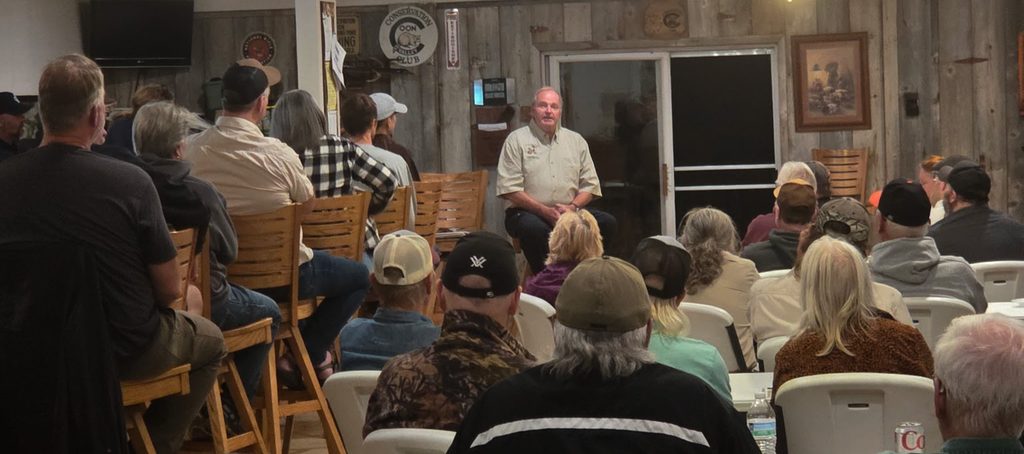
Scott spoke to the CCCWC at our Oct. 7th meeting. Photo by Tucker Gretebeck
Sydney Widell | Watershed Coordinator
With gun deer season winding down, we thought it would be a good time to revisit some of Driftless deer population facts and figures wildlife biologist Scott Craven shared with our Council when he joined us for our meeting in October.
Scott is a professor emeritus at UW-Madison and the former chair of its Department of Forest and Wildlife Ecology, although we knew him best from his countless appearances on WPR’s Larry Meiller Show over the years!
When Chronic Wasting Disease (CWD) was first detected in Wisconsin in 2001, Scott was tapped to serve on the state’s response team. After more than two decades observing the effects of the fatal disease as a wildlife researcher as well as an avid hunter in Southwestern Wisconsin, he had some words of caution to share with the Council.
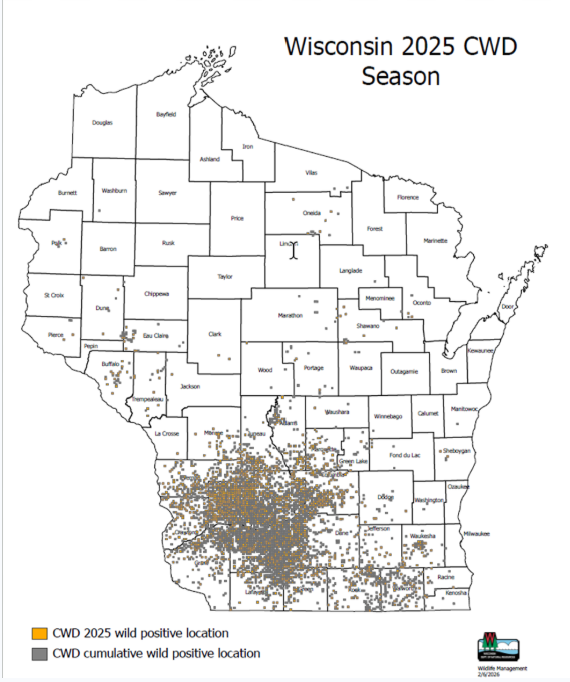
In 2025, CWD continued to expand outward from Iowa County, where the disease was first documented in Wisconsin. Southwestern Wisconsin remains the most impacted part of the state. Map courtesy Scott Craven.
As many are well aware, CWD is an incurable disease that causes death in deer and other cervids by destroying their nervous systems. While there is no strong evidence that CWD can spread to humans yet, Scott reminded us that related diseases—like Mad Cow Disease, have been known to make the leap. That’s why the U.S. Center for Disease Control strongly discourages people from consuming meat from CWD-infected deer.
In deer, CWD progresses slowly over 18-24 months. During that time, infected animals spread the disease throughout their environment. According to Scott, highly concentrated deer populations are especially conducive to CWD transmission.
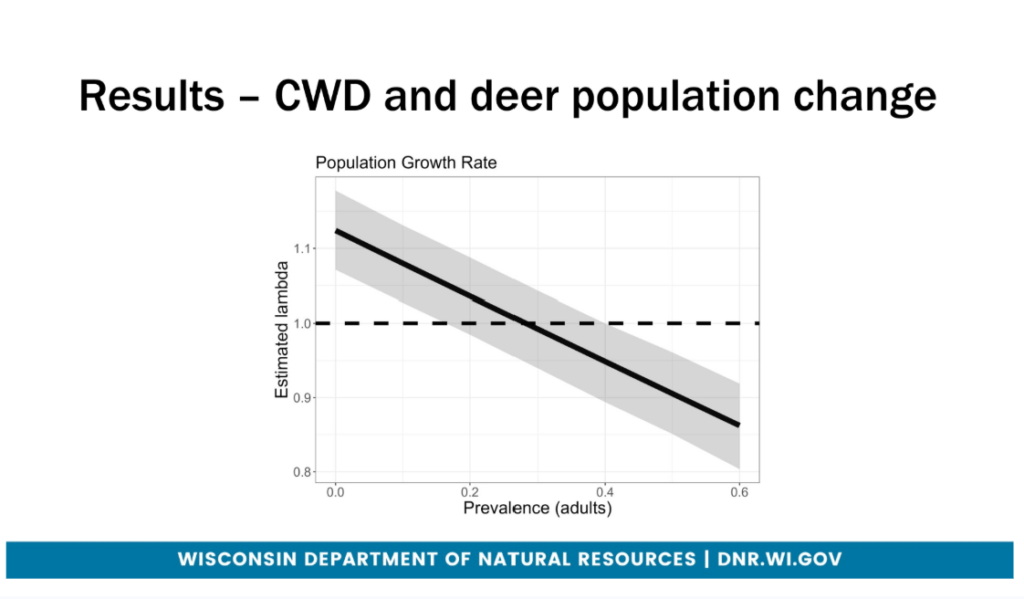
As CWD prevalence increases, the deer population growth rate drops. Figure courtesy Scott Craven.
Since CWD was detected in Wisconsin in 2001, the state’s deer herd has shrunk by about 25%, Scott estimated, although the decline is not solely attributable to CWD.
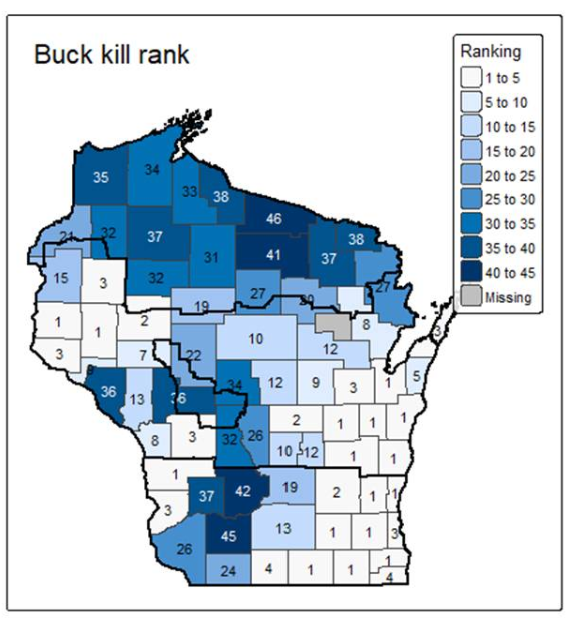
2025’s Buck Kill Rank data is one way to visualize the state’s declining deer population. Lower rankings (with 1 being lowest) indicate higher buck kills relative to past seasons, while higher rankings indicate counties where the buck kill lagged. Increasing ranking can be linked to shrinking deer populations, as well as hunters’ reluctance to harvest bucks in areas known to have high incidence of CWD. Map courtesy of Scott Craven.
While the deer population is declining statewide, it is still growing in some areas—including in Vernon County.
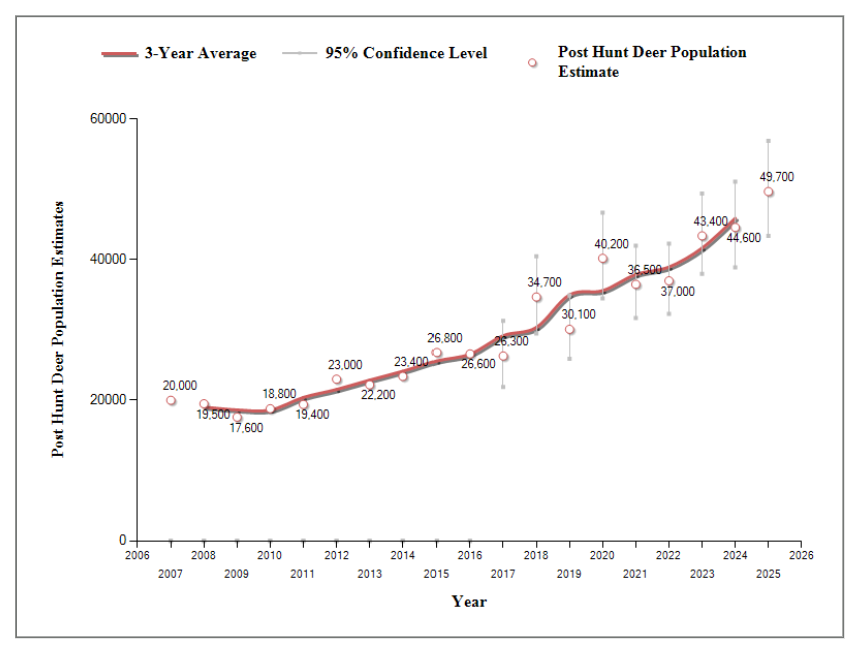
Post Hunt Deer Population Estimates for Vernon County suggest that deer populations here continue to grow. Figure courtesy Scott Craven.
The growth of Vernon County’s deer herd, coupled with its proximity to the epicenter of the state’s CWD outbreak, makes managing the disease’s spread even more challenging.
“One aspect of slowing down CWD is keeping a handle on the deer herd [through harvest and other management interventions],” Scott told us in October. “But here we are with one of the largest deer herds we’ve had perhaps in modern times. That doesn’t square very well. Don’t shoot the messenger, but the situation with CWD is, in my opinion, very bad.”
Without active deer management to keep disease spread in check, Scott warned that CWD will manage the deer herd for us. In that scenario, we’d see a shrinking population skewed toward younger deer, along with widespread CWD prevalence. Deer, which have been a cornerstone of Indiginous foodways in this region for time immemorial, will become increasingly risky to eat. And fewer people will venture out into the woods to hunt every season.
With these changes come potentially fatal human health risks, the loss of cultural traditions, devastating impacts to rural economies that depend on hunting, and increased disconnection from the land and the seasons.
“This is not the way we want to see our deer herd reduced,” Scott said. “We have enough problems with the disease that we need to have a smaller deer herd.”
Despite these challenges, Scott said Coon Creek hunters and landowners can help keep the deer herd healthy. Here were some of his suggestions:
- Hunters can harvest more deer. Deer they don’t use themselves can be donated to food banks through the WI-DNR’s Deer Donation Program.
- Private landowners can open up their lands for hunting. They can also set terms for hunters, including requiring that hunters practice “earn a buck.”
- Check out Sharing the Land for more ideas on building partnerships between landowners and access seekers.
- Wisconsin could re-instate its Earn-a-Buck program. It could also reward hunters that harvest CWD positive deer, including by adopting a version of the Pay for Positives proposal.
- Nonhunters can get their hunting liscences and head out to the woods!
Scott ended the night with a reminder that the health of Coon Creek’s deer population is fundementally connected to the health of the broader watershed. He pointed to studies in Northern Wisconsin which show that, when the deer population is reduced, everything from native plant species diversity to the abundance of songbirds increases.
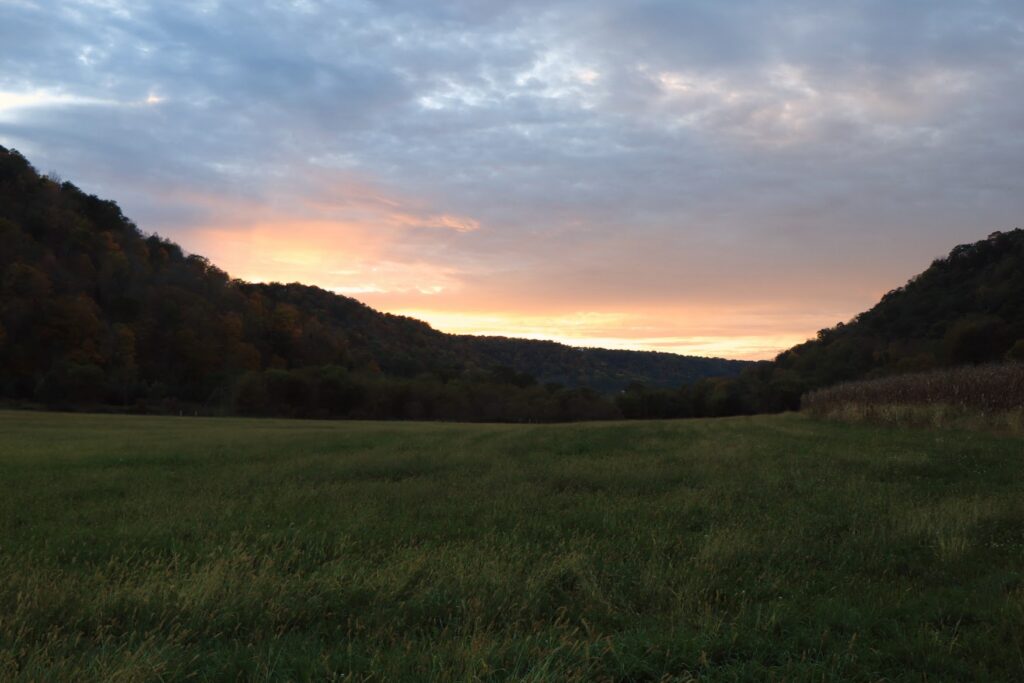
October in Timber Coulee.
We think its also important to consider the impact deer might have on flood resilience, water quality, and soil health.
At this point, it’s well doccumented that our forested hillslopes can play a significant role in infiltrating runoff and reducing flooding. Deer, which Scott called “keystone herbivores,” help determine what those forests look like. Because deer avoid browsing on buckthorn, they can shift forest compostion to favor this invasive shrub by leaving it on the landscape and removing its compitition.
After Scott’s presentation, I wanted to learn more about the impacts of buckthorn on forest soils. What I found is that buckthorn affects soil by changing both its chemical composition and its physical structure. First, because it leafs out before most native plants and keeps its leaves longer into the season, buckthorn shades out other native understory plants like grasses, whose deep roots help stabilize forest soil and infiltrate runoff. When shallow-rooted buckthorn replaces these other, deeper rooted plants, it can result in the overall destabilization of the forest floor.
Second, buckthorn’s leaves contain as much as five times more nitrogen and are also known to decay much more rapidly than leaves of other forest trees. Not only does the change in soil composition caused by buckthorn leaf decay result in bare ground, but it can lead to increased nutrient input in downstream waterways.
Conservationists in our nearby St. Croix River Watershed have argued that that the loss of native understory plants and changes in forests caused by buckthorn likley have an adverse effect on water quality by increasing runoff areas from bare soils, which can increase erosion and sediment loading downstream.
High density deer activity can directly lead to soil erosion too. Research on the catchment scale impacts of Sika Deer in Japan has shown that increased deer population density is related to increased soil erosion rates, as well as decreased downstream aquatic community diversity. The researchers noted that “It is no exaggeration to say that the success or failure of forest floor vegetation recovery aimed at restoring the water and soil conservation functions of forests depends on conservation of soil through integrated management of forests and wildlife” (pg. 411). They argued that long-term, holistic observation is necessary to identify these impacts, and to understand how all aspects of a watershed respond to wildlife management.
Is our own growing deer population contributing to the spread of buckthorn in the Driftless, and is that spread linked to changes in our forest hydrology? We can’t say for sure just yet! But maybe it’s another strand in the complex web of relationships that determines how water moves in the Creek Watershed.
Let me know what you think, and what you observe in the woods this season!