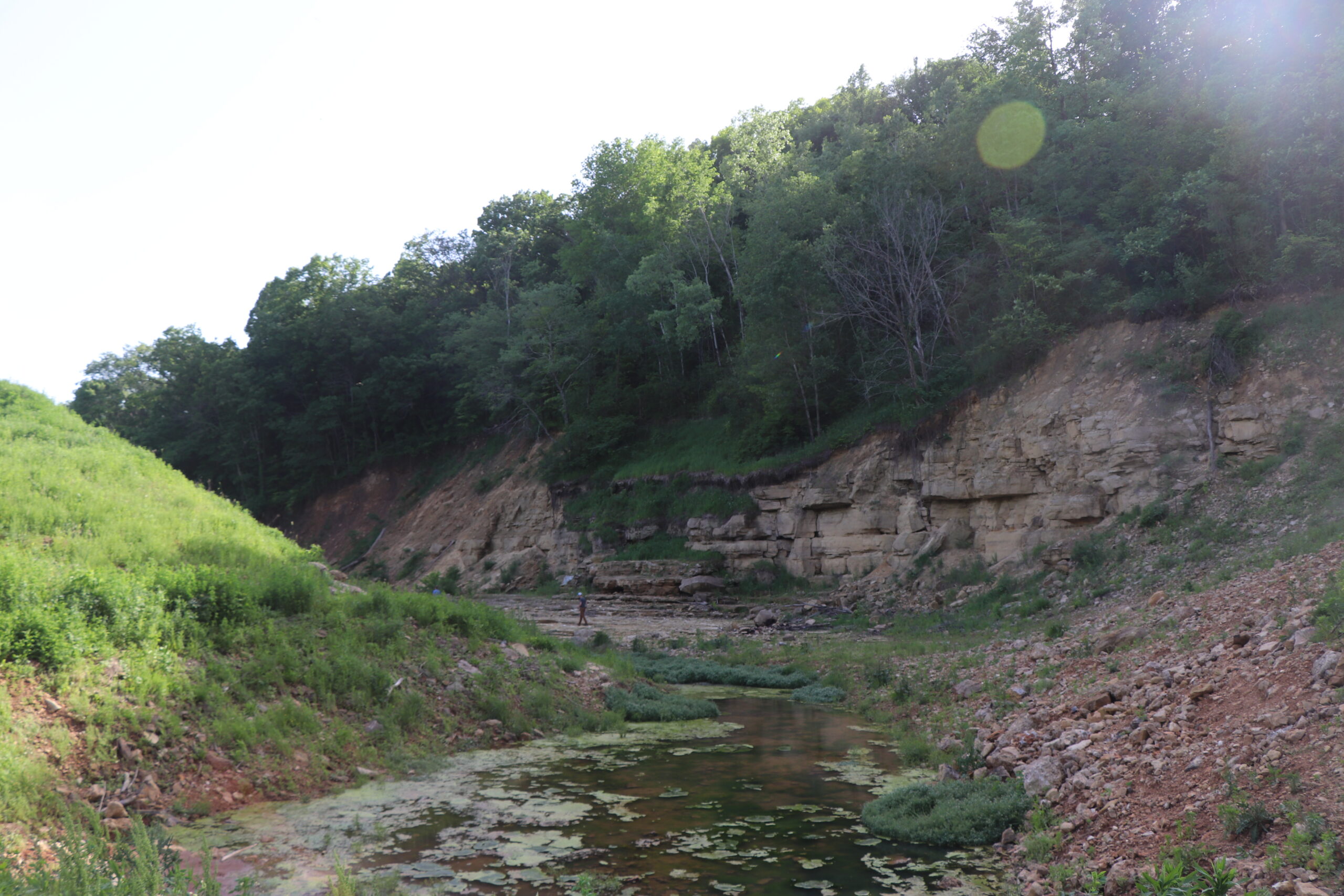
A view of the Jersey Valley flood control dam, which failed in 2018’s record floods. Environmental historian Joshua Nygren looks to Driftless Area dams like this one as a case study to examine the long term impacts of midcentury conservation programs.
Sydney Widell
The federal recommendation to decommission all fourteen of the Coon Creek Watershed’s aging flood control dams–what would be the first basin scale flood control dam decommissioning project in the nation–drew widespread community concerns that touched on everything from public process to land management. Environmental historian Joshua Nygren argues that these concerns have been around as long as the dams, and that the dams have always been contested.
“A lot of times, we look back and the dams seem like this unstoppable or inevitable force,” Josh said. “But I don’t think people living on the land viewed the dams as inevitable, and they weren’t without tremendous human cost.”
Josh is an associate professor at the University of Central Missouri interested in the political and economic dimensions of environmental protection. He explores the legacy of flood control dams and other midcentury land management practices in his new book, The State of Conservation: Rural America and the Conservation Industrial Complex since 1920.
The Coon Creek Community Watershed Council is pleased to welcome Josh at our June 4 meeting to share more insights from his research. We’ll meet at Jersey Valley County Park at 6pm for dinner, and Josh will speak at 6:30. We’ll also have free copies of Josh’s book available. As always, the event is free and open to all.
I had a chance to speak with Josh about his book earlier this week. The following is an expert from our conversation:
SW
You are based at the University of Central Missouri, but I understand you have ties to Wisconsin. I was hoping you could tell me a little bit more about your background here, and what got you interested in the history of conservation.
JN
Absolutely. I was raised in Northeast Wisconsin, the other corner of the state, and I spent a lot of my childhood in the county forests of Marinette County.
When I went to grad school, I was always hovering around questions about conservation–about how people conserve nature while also using it, and how they interact with the government in order to do so. And eventually, this circuitous path of research brought me to agricultural conservation. And when you’re talking about agricultural conservation in the 20th century United States, you have to talk about Coon Creek. It has this deserved and widely recognized reputation as a conservation success story, and it enabled me to come home and do research in my home state.
SW
Could you tell me more about what you mean by conservation, and the way that idea evolves over the timespan you cover in your book?
JW
Really what I’m looking at is agricultural conservation, which is shorthand for soil and water conservation. I’m looking at how and why farmers, the state, and industry collaborated to control erosion.
Controlling soil erosion is really the constant, but it takes on all these different layered meanings over the years.
It means something different during the Great Depression, than it does during WWII, than it does during the 1950s and 60s, and into the 80s and 90s. It’s a malleable concept, even though practically speaking, it has this through line of people doing work on the land to control erosion, and maintain productivity. And in some parts of the 20th century, it had this additional meaning of social sustainability, of maintaining communities. Keeping soil on the land, and keeping people on the land as well.
There’s this understanding that during the 1930s, especially during this unprecedented economic crisis that has all these different environmental and social dimensions to it, not to mention political dimensions, there’s an understanding that some pretty experimental methods need to take place to stabilize rural America. People are losing their farms.
And there is this understanding that if you can stabilize the environment, you can stabilize the economy, you can stabilize society, you can stabilize the political system. The emergency of the moment created more space for frank discussions about government interventions to keep people on the land.
SW
And a lot of this starts in the Coon Creek Watershed. Can you give an example of the types of programs that were at work in the Coon Creek Watershed during the 1930s?
JN
Coon Creek was home to the nation’s first demonstration project. These were organized around watersheds. A watershed would be selected, people would have a chance to sign up voluntarily, and if they signed up, they were obligating themselves to certain things, but they were also getting certain benefits.
They were obligating themselves to participate in federal social and economic studies, like, ‘you are going to keep a record book about how your finances are affected by this.’ They were obligating themselves to install certain features of conservation farm plans, they are going to provide certain materials from their own land. Maybe it’s stone, maybe it’s timber. And they’re going to allow visitors onto their land to demonstrate the virtues of what they are practicing.
But you also got a lot in return. You got things like free expertise from the federal government and soil conservation experts. You got free labor from the Civilian Conservation Corps, that much heralded New Deal program. Maybe this is one of the more under-appreciated aspects of the program in Coon Creek project in particular, but you received free lime and free alfalfa seed. The Driftless Area soils were slightly acidic, and alfalfa is sensitive to acidic soils, so they needed to be limed. So farmers had this incentive. Yes, they are maybe sacrificing some of their private property rights, but they are also getting a whole bunch of benefits in return.
And this is probably the reason, if you had to pick one, that Coon Creek has this reputation as a conservation success story: Over 50 percent of the farmers in the watershed participated, and most of them stuck around for the entire duration of the project–the full 5 years of the agreement. The signature conservation technology that emerges–and really comes to define much of the Driftless Area–is contour strip farming, which spread from there. And it’s still this visible symbol on the landscape of what conservation can do.
After these demonstration projects proved the effectiveness of conservation, the federal government started to transition into this decentralized program of conservation districts. There are a few different reasons for that. Basically, conservation demonstrations were really expensive, and they were only within the project boundaries. If you were in the project area, good for you. If you weren’t, you might see that–hey it works, but you would have to foot the bill entirely yourself. So there was an attempt to reduce overall costs, and also distribute them more broadly.
SW
How did soil conservation evolve from what was going on in Coon Creek in the 1930s into the 1940s and 50s? What elements of the 1930s approach stayed, and what changed, and how does the conservation industrial complex emerge in the midst of all of this?
JN
World War II changed the national priorities significantly. It becomes less about keeping people on the land, and instead it becomes about contributing to the war effort.
After World War II, there’s this understanding that we pushed the land during the war, even though we were trying to conserve it. And we really need to accelerate conservation to make sure we don’t lose soil. And what can accelerate that? Well, a bulldozer can move a lot more earth than someone with a scraper and a mule. These mechanized methods can get a lot more work done in a shorter period of time.The relationships between government and industry that were established during the war solidify after it.
And in that process, the meaning of conservation changes, and the people and institutions participating in it also change. One of the ways that meaning changes is that the imperative of keeping soil and people on the farm vanishes. It really loses emphasis. And it’s during that period of World War II, and the post-war period of the late 1940s that the conservation-industrial complex comes into being.
The conservation-industrial complex is a term I came up with to describe the relationships I was seeing in my sources, especially archival sources, non-published sources. These are relationships that bound together a lot of different groups and united them in a shared interest in soil and water conservation. We’re talking about the federal government, especially the executive branch (the USDA, especially the Soil Conservation Service). But there’s also Congress, there’s private industry, and at this point in private industry, we’re really talking about heavy machinery manufacturers. There’s John Deere, there’s International Harvester, Caterpillar Tractor, and those sorts. And there’s also all of these diffused groups, like individual farmers, farmer groups, conservation districts, private contractors who own the heavy machinery to do all this work and then get paid through all of these incentive programs. And it’s really the conservation-industrial complex that I think helps explain the trajectory of much of 20th century agricultural conservation.
SW
You write that a lot of people are benefiting from the set of relationships that comprise the conservation industrial complex, but you also point to a lot of the dangers–the inequities that, if it doesn’t create, it further inscribes on the landscape. Could you speak to some of those?
JN
There are benefits, but there are also costs to promoting these kinds of mechanized methods. For one, they are expensive. And one of the things I found in source after source, and especially in advertisements geared toward farmers, is: don’t frame it as an expense, frame it as an investment.
Yes, it costs a lot, but it’s going to pay off over time. And that tells me that farmers needed convincing, that farmers weren’t automatically going to embrace them. If they wanted to invest in this machinery, that’s just more money that they have to put up front. They’re often going into debt. To go into debt, they have to expand their acreage. And to expand their acreage, they have to engage more and more in market production, and that exposes them to the vagaries of the market.
So there’s a lot of reasons why some farmers were resistant to these practices. And the fact that World War II blows up that whole social-sustainability dimension of conservation, there wasn’t that federal policy goal to keep that economic goal in check, to keep that economic influence within some sort of boundary. So from 1940 to 1960, the US farm population dropped by nearly half–from nearly 30 million to 15 million in those two decades. I’m not arguing that conservation caused that, but I do think it contributed to it. It was part of the larger push towards mechanization in agriculture more broadly.
By the 1960s, that’s when we see the most pushback amongst people who are on the losing end of this. I’ll give you an example, a Coon Creek cooperator, this farmer named Frank Kotek. In 1946, he writes a letter to Marvin Schweers, who was an administrator for the Soil Conservation Service in Wisconsin. He’s talking about how conservation has really made his farm. He has increased butterfat production by something like 67 percent in the 5 years he was a cooperator, he loves strip cropping, he’s totally on board.
But by the 1960s, Frank Kotek has retired. In 1963, his son writes a letter to his senator, Bill Proxmire. And this letter basically says, “I need you to help my dad.” He’s retired, he’s living off Social Security checks and a small beef cattle herd, and he’s on hilly land.Well, that hilly land is set to be flooded by a flood retention reservoir that is part of this other program that emerged in the 1950s–the Small Watershed Program. In the 1950s, it created 14 dams in the Coon Creek Watershed, which I know you all are very familiar with. Frank’s son, Elmer Kotek, is writing to Bill Proxmire saying, “ I can’t put into words how important this is for my parents. I know we probably can’t cancel this project entirely, but can we at least delay it until my parents have passed on?”
I see in Frank Kotek’s story, the story of how agriculture more broadly–and conservation within that system–is becoming bigger and bigger. That imperative of “Get big or get out” is not isolated to the 1970s and Earl Butz, who was the Secretary of Agriculture under Richard Nixon. That was the model going back to the 1950s, including by Earl Butz’s mentor, Ezra Taft Benson, who was Secretary of Agriculture under Dwight Eisenhower.
The Kotek story shows how even people who benefited from this system could have the land pulled from under their feet by it. Or submerged under water, I suppose. And it also shows how heartbreaking this was for a lot of people who didn’t want to lose their land.
A lot of times, we look back and it seems like this unstoppable or inevitable force, and maybe this was an inevitable thing, but I don’t think people living on the land viewed it as inevitable, and it wasn’t without tremendous human cost.
SW
That story is new to me, and it’s devastating. We are definitely familiar with the PL566 program, or the Small Watershed Program that you were talking about. This is, like you said, the program that built the 14 dams across the Coon Creek Watershed that also saw system wide failures in 2018, and that are currently at the center of the first basin-scale decommissioning project in the nation. I was hoping you could talk a little more about that program and how it interfaces with the conservation-industrial complex.
JN
The 1950s were a decade of hydrological extremes. Some parts of the country were submerged under floods, and other parts were devastated by droughts. There were a number of people who had made arguments starting in the 1920s, and probably before, that if you practice soil conservation, it will soak the water into the ground and decrease the severity of floods–maybe even prevent floods altogether. The official name of the 1954 law that created that program is the Small Watershed Protection and Flood Prevention Act.
Flood prevention–the idea that you can not have floods ever again–was the justification of it. The goal was to really level out hydrologic extremes. If you could build a series of flood prevention reservoirs–like the big ones in Coon Creek, but also farm ponds on land owners’ property, you could store water in times of plenty for use in times of need.
It was a really compelling idea. In the first 8 years, the program expands four times to include uses like municipal water supply, irrigation, fish and wildlife habitat, and outdoor recreation. And what each of those things do, is by having these authorized purposes, they can add to the cost-benefit calculus going into these projects, especially on the benefit side.
But the cost-benefit analysis could get a little shady, because the dams were pretty expensive. If the cost-benefit analysis didn’t meet the federal minimum, they would get creative with the numbers. Like maybe this dam doesn’t pay for itself, but if we take the entire river basin–and maybe we expand out to a larger river basin if we need to–we can substitute that larger cost-benefit ratio. And if there’s a positive ratio for the entire basin, we can apply it to the individual dam that couldn’t meet the expense justification on its own. I don’t have evidence that this took place in Coon Creek specifically, but I have evidence that it was taking place elsewhere in the country.
You also asked how dam building factors in with the conservation-industrial complex. Earth moving manufacturers–Caterpillar, International Harvester–they see this as a boon. They estimate that this is going to create millions of dollars in annual business for them. They think this is going to create as much business as the Interstate Highway Act of 1956, if not more. A lot of them are sponsoring advertisements. They are selling a government program to readers in suburbia. This is in the Saturday Evening Post, this is in Time Magazine, US News and World Report. These readers aren’t going to be buying a bulldozer. But they can support the Small Watershed Program. Manufacturers are pouring money into supporting this government program, because ultimately it generates more money for them, because they are selling bulldozers, scrapers, and things of that nature to private contractors.
SW
You spend a lot of time researching the way these relationships played out in the Coon Creek Watershed, but you also look at watersheds in other parts of the nation, especially in the Southeast US. Can you describe some of the similarities and differences in the way agricultural conservation was practiced in Coon Creek and elsewhere, and also in the impacts of the conservation-industrial complex?
JN
I think some of the similarities are that nationwide, this is a decentralized apparatus. It is a decentralized program that is empowering local people to be decision makers. That decentralization often came with very little federal oversight, which could be good or it could be bad.
If you are creating a flood retention reservoir, you are flooding someone’s land. And most of the time, people did not like their land being flooded. Decentralization buffered the Soil Conservation Service from criticism. They could say, ‘Sorry, that’s not our problem, go talk to the local people.’ Well, the local people are the ones flooding their land. So it put these local leaders, who were often more influential people within the community, in the position of both the defendant and the judge. It made it difficult for other residents to challenge any of these projects.
Some of the major differences, especially in the Upper Midwest compared to the Deep South, would be the racial and ethnic makeup. In the Upper Midwest, these are largely homogeneous communities, whereas in the South, there were stark racial divides that were prominent and more common. I think all small farmers were at a disadvantage. Class was at play, but in the South, race was added on to that. To be a poor farmer was one thing, and to be poor and Black made it even more difficult.
Very few African Americans sat on these local governing boards. The Jim Crow era was when a lot of this was really taking off. Even after the 1964 Civil Rights Act, some of these officials in the South are staunchly opposed to desegregation at any level, even at a token level. Since 1920, if Black farmers had left farming at the same rate that white farmers had–and this is based on someone else’s work–there would have been around 300,000 Black farmers on the land in the 1990s. Instead, there were fewer than 20,000. A lot of the dynamics that led to disenfranchisement and even land dispossession in the Midwest are intensified in the South, and disproportionately affect Black farmers.
The conservation-industrial complex made it seem like the hemorrhaging farm population was good for the land. Some conservation advocates cheered on land consolidation. But even those who didn’t still justified land consolidation as good for nature. Starting in the late 1940s, you start to see prominent figures in conservation saying, essentially, ‘some farmers may be squeezed off the land, but those who remain will be in a better position to care for it.’ So, environmental protection is mobilized to defend the consolidation of land, which is really the consolidation of wealth.
Another thing that was more intense in the South was stream channelization. That was a practice promoted under PL566 that had some pretty powerful backers in Congress making sure their districts were getting disproportionate benefits.
Stream channelization is a flood mitigation tactic where they straightened, deepened, or widened streams in order to flush more water off the land more quickly, but that destabilized entire hydrological systems both up and downstream. There were some key legislators who I talk about in the book who, in part thanks to Jim Crow disenfranchisement, had seniority power and were in charge of these committees, and they got to say what types of practices were being funded or not.
SW
What can we learn from this history? Can current approaches to agricultural conservation resist the tendencies that you identify in your book, and repair some of their historic damages?
JN
One of the things I hope readers get from my book is that not all conservation is the same. Conservation is one of those words that everyone can get behind. It’s a big tent concept, but what exactly it seeks to do matters tremendously.
Reliance on expensive technofixes might solve one problem, but it often creates wholly new problems. Today, a lot of these fixes are promoted as tools of sustainability that are going to help farmers produce more from less land, with fewer inputs. That might be true, but that’s not the entire story.
The rise of digital agriculture more recently, where you have self driving tractors, and all this high tech equipment that monitors real time field conditions and tells people exactly how much fertilizer and pesticide to apply per square foot, I hope people see those as not just neutral technologies. If we took as a principle that a well-populated country side is good–not out of romantic attachment to family farmers, or that sort thing, but just as a sign of an equitable society–then I think we can view[the rise of high tech, low populated farms as a testimony to the tendency of expensive technofixes to concentrate wealth in fewer people’s hands in the name of environmental conservation.
As a starting point, pay attention to how power works within agricultural conservation. Any time we’re talking about the protection of nature, we’re talking about those three big things that people were paying attention to during the New Deal. It’s about the environment, it’s about the economy, and it’s about who can actually afford to participate.